
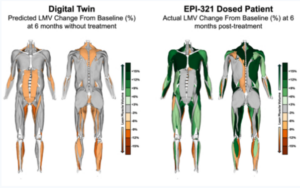
Image caption: MRI images of Lean Muscle Volume (LMV) change from baseline at 6 months for the predicted digital twin without treatment (left) and actual EPI-321 treated patient (right) 6-months post dosing. Images show LMV was predicted to decline due to natural FSHD disease progression (orange colored muscles), but LMV was observed to increase (green muscles) following EPI-321 treatment. Images are from one participant in the study, however the increase in LMV seen here was observed across all n=3 patients 6-months post dosing. Images from Springbok Analytics.
Recent news from the FSHD research pipeline has brought cautious optimism to our FSHD community. Epicrispr Biotechnologies has announced encouraging early findings from its ongoing Phase 1/2 clinical trial of EPI-321, an investigational therapy designed to target the root cause of FSHD.
Early signs of a potential disease-modifying treatment
The results reported so far come from the first three participants who were evaluated six months after receiving a single dose of EPI-321. According to the company, all three participants showed an increase in lean muscle volume, while the treatment demonstrated a favourable safety profile. Nine participants have received the therapy to date, and further follow-up is ongoing.
This finding is noteworthy, because FSHD typically causes muscles to weaken and lose volume over time. In these first participants, researchers observed gains in lean muscle volume, rather than the decline normally expected as FSHD progresses. It is still too soon to know whether these changes will lead to noticeable improvements in strength or day-to-day activities.
Understanding DUX4
FSHD is linked to gene called DUX4. In healthy muscle tissue, DUX4 is switched off. In people living with FSHD, however, it becomes activated and causes muscle damage and degeneration over time. EPI-321 is designed to silence DUX4 without changing a person’s DNA sequence. The aim is to provide long-lasting suppression of the disease-driving process and help protect muscle tissue from further damage.
At what stage is this research?
These are early clinical trial results. The ongoing study is a Phase 1/2 trial, where researchers are primarily evaluating safety while also looking for early signs that the treatment may be having a biological effect. The current findings are based on only three participants who have reached the six-month assessment point. Additional data from more participants and longer follow-up periods will be needed before researchers can determine whether the observed changes translate into meaningful improvements in strength, function, and everyday life. Epicrispr expects to present additional data later in 2026, with the first part of the study expected to end in 2027.
What does this news mean for the FSHD community?
While it is too early to draw firm conclusions, these results add to the growing momentum in FSHD research. The findings suggest that EPI-321 may be addressing the underlying cause of the disease rather than simply managing symptoms. Larger studies with longer follow-up will be needed to confirm early findings and show whether they lead to meaningful improvements in people’s daily lives.
FSHD Europe welcomes this progress and remains cautiously optimistic. We thank the people living with FSHD who participate in clinical trials, as well as their families, clinicians, researchers and industry partners whose commitment makes this research possible.
As always, further evidence is needed before the long-term impact of EPI-321 can be understood. Nevertheless, every step forward in research brings us closer to our shared goal: effective treatments that improve the lives of people living with FSHD.
Learn more